Showing posts with label analysis. Show all posts

Monday, August 17, 2015

Receivers "Running Free" & How it Happens

Football is back, baby!

The game against the Colts was fun to watch for a lot of reasons. In this quick post, I'm just going to talk about something I've noticed frequently mentioned along very knowledgeable football analysts I respect: how our receivers always seem to get so open ("running free") compared to other offenses.

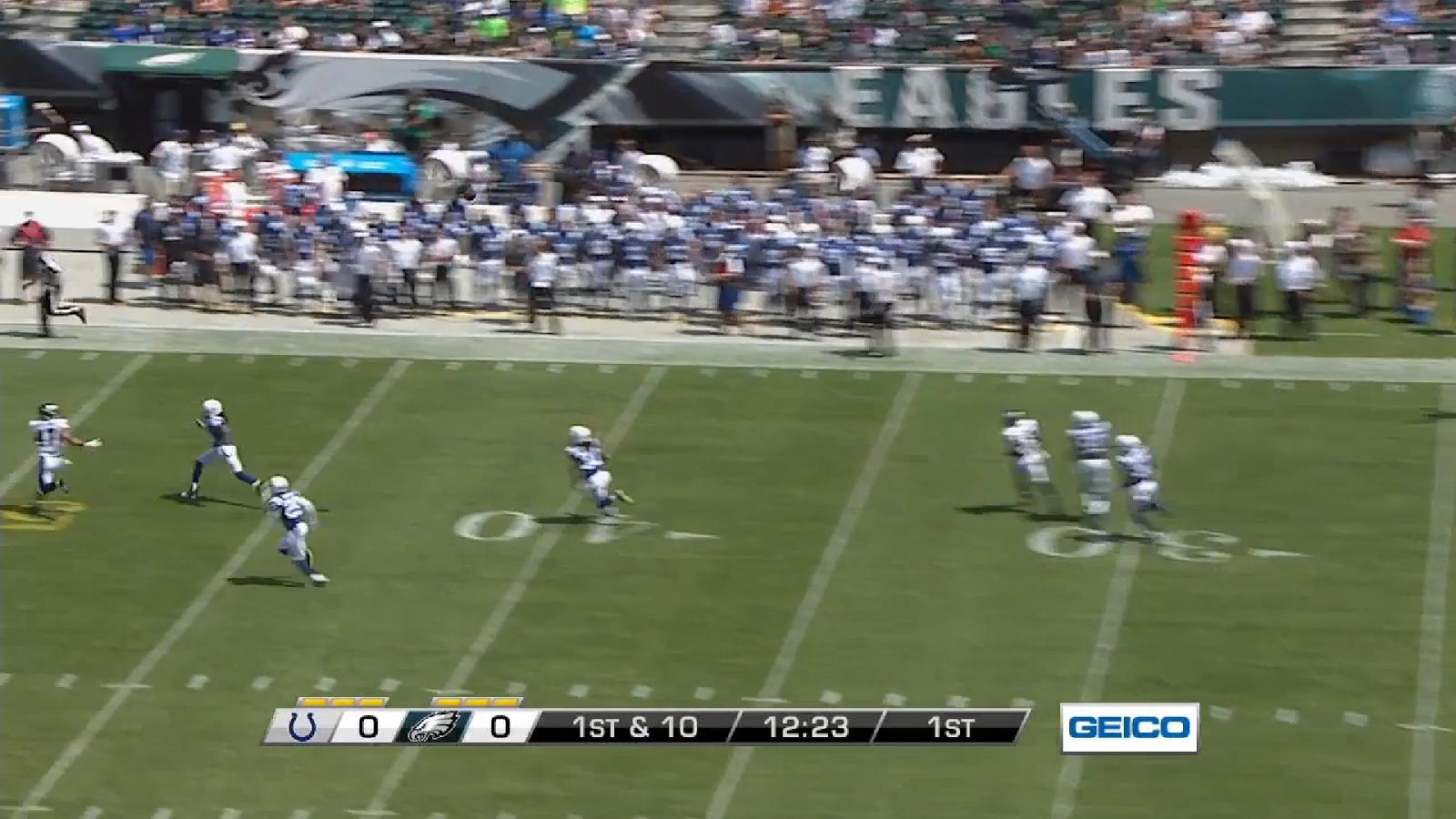
The first play I'll break down was our first offensive play of the game. Positioned at their own 20, the Eagles lined up in a two tight end bunch formation. Brent Celek and Trey Burton lined up on the right side of the formation, with Riley Cooper and Josh Huff lining up in a mirrored look to the left side. Ryan Mathews was at runningback to the quarterback's right. The play can be visualized like this:
The play was designed as an outside zone fake to the left, with a 3-level pass designed to the right. Brent Celek does not run a route, and his job is arguably the most important along the blockers on this play.

In this first screengrab, the offensive line is blocking left per the run fake. Brent Celek is circled in red along the line, sealing the defensive end. For Sanchez to safely execute his rollout, the defensive end must be sealed. Celek's the linchpin along the line for this play. The other red circle highlights Trey Burton, releasing with some serious speed vertically off of the line. The lack of a defensive jam allows him to hit the secondary with a full head of steam built up. Moreover, 6 players in the back 7 all have their eyes firmly planted in the backfield. These players are highlighted with the orange squares. The respect for the Eagles run game is one of the reasons analysts frequently talk about receivers "running free" in this offense. A dominant run game makes passing infinitely easier.


The second screengrab still highlights Celek, who has sealed his defender off from the playside excellently. The respect for the run by the defense has pulled 4 defenders away from the passing side, numbered as so on the bottom of the grab. At this point Burton has reached the secondary, and the obviously beat defensive back reaches out to try and slow him down. Burton works through the contact and finds himself running free in the secondary.


This third screengrab highlights just how open Burton has become even within just 10 yards of the original line of scrimmage. Also note the development of a conflict read for the flat defender at the top of the screen. Riley Cooper sifted behind the offensive line during the run fake to avoid a pick by a linebacker. When Cooper releases from the protection of the backfield, the unblocked linebacker has to choose to rush the quarterback rolling out, or defend the flat pass. Either way, it protects the quarterback. If he rushes, the dump pass will be open for a respectable gain, and if he stays to cover the flat, the quarterback can set up for the 9 route down the seam.


The conflict defender hesitates on his decision, allowing Sanchez to set up for the 9 route to Burton. Sanchez fails to get enough sizzle behind the ball, and under throws him. In this screengrab, we see that Burton has a 4 yard separation from the closest defender, and he has already started to slow for the ball. At peak separation a few moments before this screengrab, Burton had 5 or 6 yards from any of the defenders. An accurately delivered ball here would've resulted in a touchdown.

It all started from the respect for the outside zone.

This second play is a play that most Eagles fans are very familiar with from the second half of last season. An outside zone run fake, complete with Brent Celek linchpin block on the backside, with a scorching Jordan Matthews crossing over the middle of the field. On our second series of the game, we called it several times.


The play is run out of a formation with Brent Celek singled up on Trent Cole, and Jordan Matthews with a reduced split into the opposite slot. Darren Sproles has subbed into the game, who had a propensity to work well on read sweeps and outside zone runs last year.

This second screengrab once again highlights the eyes of the second level defenders who are being targeted with this play. Four defenders have their eyes in the backfield, and the 3 closest to the ball have taken steps to flow towards the outside zone. Jordan Matthews is highlighted in red, cutting in front of the closest linebacker and behind the second defender, "slicing" them. On the bottom of the screen, Brent Celek seal blocks Trent Cole. This allows for Sanchez to safely execute his rollout.


The uppermost red box below highlights Matthews streaking full speed past the 3 linebackers who over committed to the outside zone action. We also see Brent Celek shedding his block and releasing into the flat underneath Matthews' crosser.


 At the point in the play, the linebackers have realized their mistake and start to flow back into coverage. It's too late for them, though. Jordan Matthews seems to be running free again, with trailing defenders looking foolish behind him. Moreover, we once again present a conflict read for the hook defender. Celek has released from his route. The defender over top of him jumps his route, opening up the throw to Matthews even more. Had he recognized the crosser and dropped to cover Matthews, Celek would've been wide open with the checkdown. Say Cole sticks with Celek and nobody is open? Sanchez can then run the ball for a modest gain. The design of most of Chip Kelly's plays follow this mantra: if executed correctly, the defense can never be correct.


The hook defender bites down on Celek's route, and Cole cannot get to Sanchez quick enough. Matthews is streaking across the middle headed towards the endzone. Gotta be a touchdown, right?


Sanchez once again overthrows the wide open receiver. So no, no touchdown. An accurate ball here is easily a touchdown.


Keep listening throughout games and you'll start to consistently hear about "simplistic" reads and receivers "running free" in this offense. The root of that isn't really that tough of a concept to grasp: run the ball well, and everything else gets easier. Also, packaging simple reads to put selected defenders in conflict simplifies things even more, making quarterbacks look even better.

Now, if only we could get an accurate quarterback who makes good reads and can get the ball down the field efficiently, we could really be cooking something good here.

Saturday against the Ravens can't get here soon enough.

Tuesday, May 5, 2015

Psycho, the Okie, and the Joker


Yesterday's post about the Psycho defense made quite a few waves in the Eagles community, particularly over at r/Eagles, and I got a lot of great feedback. Rather than edit that writeup severely, I decided to put some more thoughts into a second part. This part will dive deeper into the psycho defense, and the two lynchpin pieces of the subpackage: the "okie" and the "joker."

Dom Capers in Green Bay runs a 1-5-5 Pyscho front. Their lineup looks something like the following:
This orientation differs slightly from the lineup used in the previous piece, in that there is only 1 down lineman, and we've added a nickel corner/safety/linebacker hybrid in the place of the other down lineman. This player can be referred to as the "okie" and their job is to confuse the opposing quarterback by being able to execute a myriad of assignments from the exact same setup.

The most famous and recent example of the okie psycho defense being used was during the Packers 2010 Superbowl run. That year, they had an up-and-coming nose tackle in B.J. Raji, and a savvy defensive veteran who knew the defense inside and out in Charles Woodson. The rest of the pieces fell in around them. Certain analysts maintain that a game changer at nose is not necessary, and this may very well be. However, the three teams I've seen run it best as of recently are the Green Bay Packers, New England Patriots, and Baltimore Ravens. B.J. Raji, Vince Wilfork, and Haloti Ngata, respectively. The Eagles do not have a dominant nosetackle on the roster currently. Fletcher Cox is the closest we could come to that, so he would most likely be inserted here, as his combination of athleticism and size might make him the perfect prototype for this subpackage moving forward.

The okie's responsibility is to disguise his assignment as best he can until the play starts, and then execute whatever he has been assigned from wherever he is on the field. Most frequently, the okie will either line up in the slot over a receiver, or lineup with the linebackers, albeit usually shaded to one side rather than right up the middle in the A or B gaps (this is the joker's role, we'll get to him later).

Charles Woodson represtented the prototype for what is wanted out of the okie position. Woodson played corner for the first few years of his career, but as his speed started to wane, his football smarts only sharpened, and Capers decided to use him as more of a safety/linebacker hybrid. Physicality is required out of the player, as they will be asked to attack guards, tackles, and tight ends on blitzes. Athleticism is required because they will be required to drop and play zone and man coverages, depending on the defense called. Being able to disguise ones assignments and get into a quarterbacks head is also a key of the position. It's a selective set of skills that isn't particularly common.

To get an idea of what Charles looked like running as the okie, check out the following gif. This psycho look is run with two down lineman, much like the version I drew up in the previous post, and 4 linebackers. Charles Woodson initially lines up in the slot at the top of the screen, not showing his hand (blitz) until the play is already progressing.


Back during the dreaded 2012 season, Juan Castillo tried using Nnamdi Asomugha in a similar role. His cornerback skillset was lessening quickly, and out of panic they tried to find him a role that could work considering how much they paid for him. It didn't work particularly effectively. He did a fine job covering tight ends that year, but thats not really the job of the okie. He was just a glorified dime linebacker, to be quite honest. This position is quite specific in what it calls for. Nnamdi had the smarts and the coverage ability, but physicality was never his strong suit.

The "joker" is the other part I am going to talk about. There is less out there regarding the specifics of what the joker entails in any given defense. His obligations in the psycho are to move around the defense, lining up anywhere from the A gap over the center to the C or D gaps outside the tackles, and rush approximately 75% of the time, dropping occasionally but with much less frequency than the okie. Just enough to keep the offensive line guessing, more or less.

The joker position has many names in many different defensive schemes. Recently, with the acquisition of Julius Peppers, Dom Capers installed an "elephant" position on his defense. In this article, Green Bay head coach Mike McCarthy gives the definition of the position. "'Elephant' is a term used for a multiple-position player along the defensive front," and goes on to explain that the exact responsibilities of the position depend upon the player. 

Jim Johnson used to use Jevon Kearse as a joker of sorts, moving him around the defensive line and lining him up with his hand in the ground or a stand up linebacker. The position requires excellent lateral agility as well as strength and pass rushing ability. The player best suited on our defense to do this currently is Connor Barwin. In fact, he has already been used in a joker role quite a bit as an Eagle.

Against the Seahawks this past season, if their offense was facing a 3rd-and-5 or longer, there was a good chance Vinny Curry was lining up at DE, Fletcher Cox was playing NT, and Brandon Graham or Trent Cole was the other DE. Connor Barwin then played the joker role, bouncing around the A- and B-gaps prior to the play, with Nolan Carroll in as a dime linebacker and Mychal Kendricks playing ILB. Here are a few screengrabs, Barwin is circled in red:


 Barwin's position is fluid. In this game, he mostly focused on rushing up the A gaps (just to the left or right of the center) or playing as a "spy" on Wilson, a dangerous threat on the ground.

Two more screengrabs, both on the same play, show Barwin initally line ups to Cox's right, but stunting to his left just prior to Wilson calling for the ball. Also, I highlighted Cox in the black square to point out that we have Cox running point on our defensive line, so using him in the mold of B.J. Raji or Haloti Ngata is clearly not too much of a stretch.


The joker is already a clearly used position on our defense, but the role could be expanded if a psycho package is indeed installed this offseason. I would expect Connor Barwin to continue to get those looks, as his combination of skills allows him to execute what he needs to do perfection at that position.

The Eagles do not have a clear cut okie on the roster currently. However, the past two drafts have seen them select players that could be fitted into the role, given their physical and mental traits. Two years ago we drafted Jaylen Watkins, a CB/S hybrid player, and this offseason we selected Eric Rowe in the 2nd round, a CB/S hybrid. Watkins looks to me like more of a corner, but apparently he is putting on weight to compete at safety this summer. Rowe is the more compelling case for me.

When you put tape of Rowe on, you see a physical corner who does his best when he is at the line of scrimmage across from a receiver. He is not afraid to tackle ballcarriers, and has a nose for contact. Physicality? Check. 3 years at safety and 1 year at corner at Utah show that he is more than flexible enough to learn new positions, and he has the brains to both call a defense as a safety, and react in one as a corner. Mentality to play the position? Check.

Athleticism? Check out his spider chart, which references his Combine measurables compared to other cornerbacks over the past 16 offseasons.


Check.

Coverage? Ball skills?


I rest my case.

I think we have the defensive players in place to run a Psycho Okie Joker package with the best of them. It will get our deepest positions onto the field the most, and allow us to rotate and stay fresh. We know Chip has run concepts like this in the past at Oregon, and he is accruing talent that makes one wonder if he and Billy Davis are going to work some things up on the whiteboard this summer.

Monday, May 4, 2015

What to do at ILB?


Inside linebacker is a mess, for lack of a better term. Nobody outside of the Eagles organization knows what Chip is planning to do with the litany of talent we have in the middle of our defense. It's confusing, and the easy answer is that someone has to go. The conjecture on twitter and over at Bleeding Green Nation is that Mychal Kendricks is good as gone. I'm not so sure about this.

For one, I am skeptical because I simply don't want it to be true. He does nothing but good things on the field when he's out there, whether it be his explosive pass rushing skills when he's called on blitzes, or his guaranteed wrap up tackles. His 4.5 speed is unprecedented at the linebacker position, and I don't see why moving on from him would make our defense better.

Moreover, Chip said just recently after the draft that they are moving forward with Kendricks in the picture. However, there are rumors and rumblings that they are not attached to him in the long term. His name was floated quite a bit as trade bait for a possible moveup for Mariota. Chip has said no players were offered, but reports saying just that were numerous. I think the truth lies somewhere in the middle.

Chip has a mold he looks for at every position, this was clarified in Ed Marynowitz's introductory press conference. Kendricks is 5'11" and 240 lbs, which is most likely not in the range they're looking for. My guess? His weight is fine, it's the height they have an issue with. His 3 years in the league has shown he can play just fine without his height being an issue, but Chip has shown he has his prototype he looks for with every position, and he has not wavered much from that in his 2.5 years here. Therefore, I think its reasonable to assume Kendricks is dealt before the start of the season. However, if he stays for the year, I think he can be utilized despite our logjam at the position.

The "psycho" defensive package is a formation that uses confusion, pre-snap movement, and only one or even no down lineman to confuse offenses. Current users of the psycho defense are the Patriots, Steelers, and Packers, all 3-4 defensive teams. Dom Capers, currently of the Packers, is widely considered the innovator of the psycho package.

Chip has stressed from day 1 that he believes the best defenses come from a 2-gap 3-4 approach. The psycho defense follows a different train of thought completely, in that almost no two gapping takes place and the chief concern is to get to the quarterback, even if you are opening up yourself to gashes with the run game. Therefore, this defense is not used extensively on a permanent basis at the pro level. However, used as a sub package, it can be an effective tool.

The basic idea would look something like this:
This iteration of the defense would involve a 7 man box, leaving room for two safeties and two cornerbacks. The Eagles have shown a tendency to prefer a heavier box than bringing in a nickel corner, as shown by Brandon Boykin's decreased snaps from 2013 to 2014. Stopping the run is the imperative of a two gap 3-4, and a heavier box helps with that.

Fletcher Cox is the best player on our defense, arguably our team, so leaving him on the field is a no brainer. However, removing Logan and subbing in a corner or perhaps adding another linebacker would be another iteration of the Psycho defense.

Has Chip run a psycho package before? You bet he has, as evidenced by the following screengrabs. We have seen nothing like this in the past two years with Chip and Billy Davis at the helm, but we didn't even have a dime package until year two. They can only install so much at a time, I suppose. Putting too much on the plates of new players in a 3-4 would've been risky. I think going slow is a good approach. However, the infusion of talent we now have at the linebacker position raises the question if maybe we'll see more looks like the following in the season to come.


The thought of Fletcher Cox and Bennie Logan or Beau Allen eating up three or four lineman up front, Connor Barwin and Brandon Graham sealing the edges, and letting Alonso, Kendricks, and Ryans flow to the ball as necessary sounds pretty attractive to me. Moreover, exotic zone blitz concepts become deadly when ran out of a psycho look. The late great Jim Johnson used zone blitz concepts to craft the best defenses I've ever seen in midnight green. I am all for bringing some of those tropes back onto the field.

The chief downside that this defense brings is the possibility of getting torched by a strong running team. Linebackers can get washed away from the play from free running guards and tackles. Therefore, this defense is primarily used in third and long situations, or when the opposing offense needs to score points through the air (fast).

Say, for example, we run a basic 3-4 2 gap for the first two quarters of the game, subbing in nickel and dime when appropriate and the power spread offense we will unveil in September (more on that later) spots the defense 21 points by halftime. This has become somewhat more common under Chip. Big strong leads with quite a bit of time left in the game. I think this is when the psycho package could be deadly.

If the opposing team has a quarter and a half of game time left and then need to score 3 or 4 possessions in a row, I don't see why subbing out some of the bigger guys and using the psycho would be a bad idea. This package is a high risk, high reward package. Free rushers is the epitome of the pyscho package, and free rushers leads to quick sacks, fumbles, and turnovers.

Moreover, I do believe that our defense is better suited than most to stop the run out of a weaker front 7. Our stouter than usual outside linebackers, Connor Barwin and Brandon Graham, do an excellent job of sealing the edges and shedding blockers when runs head their way. Add in Fletcher Cox eating up two defenders and a big guy along side him, and the suretackling linebacker corps we have would be able to flow to the ballcarrier easier than a lot of other defenses in the league. A finesse defense could not do this. However, our front 7 is the opposite of finesse.

Even more exotic ideas could include Vinny Curry, Marcus Smith, and others. Curry's main attribute is to shoot gaps, not 2 gap. However, Chip has kept him on the team because he is a deadly threat to rush the passer and has at least improved, albeit little, at two gapping when he does get playing time. Subbing out Logan's spot for Curry and having him stand up and roam around with 3 or 4 linebackers around him, a few dropping into coverage and a few overload blitzing to one side could be a deadly look. Marcus Smith's best attribute in college was an edge speed rush. Perhaps letting him get on the field in a psycho look and telling him to pin his ears back and rush off the edge or on a stunt, getting his 'high school body' free of blockers, could be useful. This could look something like the following:


Some analysts have been quick to write off the possibility of keeping the inside linebacker we have now. There is a very good chance that we will go into the season without Kendricks. But now that the draft has passed and he is still on the team, I have begun to wonder if maybe Chip and Billy will craft up a few ways to get them all onto the field in certain packages and rotations.

Chip did this extensively in 2012, his last year at Oregon. We haven't seen it since. This coming season, don't be surprised if looks like the following become more common. I think the theme throughout this writeup that has shone through, is that flexibility and substitutions would be very common in a front like this. Last year, our defense was on the field for 40 minutes or more in a few contests. Keeping guys fresh should be more of an imperative this year, and this package could certainly help with that.


Edit: It's worth noting that in all four screengrabs, it's a 3rd down and long to go. Also, in two of the four screengrabs, the Ducks have big leads and are heading towards the end of the game. I laid out both of those scenarios above, without noticing the screengrabs were those exact situations. 

Wednesday, March 4, 2015

Chris Polk: The Answer?


With the departure of LeSean McCoy, there seems to be a gaping hole at running back. Or, in all reality, is it actually a very manageable deficit?

The thinking here is that Chip has enough trust in his offensive scheme, that all he requires is a running back, or two, that can read a zone blocking scheme and attack the correct hole. This isn't a particularly tall order to fill. Among all running blocking schemes, the zone blocking scheme is notorious for being easy to adapt to as a runner.

One argument made over the last few years was that for every awesome juke LeSean pulled out of his pocket, he left behind consistent yards on inside zone running plays game in and game out. Take, for instance, this past year. Think back to how many times we ran inside zone on first down. Now, if you watched enough film, it should be clear how many times LeSean was stonewalled at the line of scrimmage, or just past it, and would try to cut back. The unblocked end on the weakside, a fundamental weakspot of the inside zone, would end up corralling LeSean from the backside for a loss of a few yards.

The blur offense would benefit exponentially more from a 3 yard gain on first, rather than a 3 yard loss. Well, any offense would, for that matter. But the point sticks out with the blur more than anything. If the offense doesn't sustain drives, the defense spends around 40 minutes of gametime on the field. This is not sustainable or healthy for any defense, even great ones. And the key to sustaining drives, as we saw this past season, is starting fast. LeSean has a lot of strengths, but squaring up his shoulders and running between the hips of the center and guard was never one of them.

Is there somebody on the roster who has a tendency to square his shoulders up and hit the hole, even if the hole isn't wide enough to drive a truck through? Why, yes, yes there is. Is there somebody on the roster who has shown a tendency, in an albeit small sample size, to follow his assignment wholeheartedly even in the face of other options? Once again, yes.

In the following play, I'll highlight Chris Polk's unrelenting tendency to follow his blockers through a play. This play is an example of the 'sweep-read', combining elements of the old school sweep play, with a read element, freezing a defensive player. The sweep read can either freeze a weakside defensive end, the nose tackle, or a linebacker, it just depends on how the defense lines up. On this play the weakside defensive end is read.


Polk initially lines up to the right of the quarterback, but Sanchez waves his to the playside just before the snap adding an element of confusion to the defense. The strength and movement of the defense may very well depend on the running backs alignment, and shifting it pre-play adds a bit more thought to the defense. The old adage goes: when you're thinking, you're not reacting, and you're not playing. Make the defense think and you'll have them beat 9 times out of 10.


At the snap, Peters, Tobin, and Johnson all downblock a player, effectively sealing them off from the play. Kelce and Gardner pull from their spots at center and guard. Worth noting; Celek takes on J.J. Watt and handles his own. Polk's assignment is to follow out his blockers almost in the form of an outside zone play with the desired running lane being well outside the tackle box.


At this point, we can see the excellent job that the downblocking linemen have done. Johnson has pushed his guy so far back that there is an inside lane, highlighted in red, just begging for Polk to take. Any layman with two eyes would say that Polk is crazy to not take this, right? Watt reacts to the huge hole being developed and tries a swim move to the inside of Celek.

Note the blitzing slot corner that came in who would ruin most sweep plays, but Gardner quickly addressed him with a devastating cut block.


Rewarded for his patience and dedication to the play, look at the lane Polk is presented with. Celek understands where the run lane is, so he is perfectly content with Watt swimming to the inside. By letting him inside and then sealing him off, he's effectively left a one on one with Kelce and the linebacker. Providing Kelce doesn't wiff his block, Polk has quite a bit of yardage to deal with. I've highlighted Watt and Andre Hal, both taken out of the play with perfectly executed blocks. To top it all off, Polk ends the play in a savagely brutal manner I wouldn't mind getting used to.


Beautiful.

Next, we'll go over Polk's adeptness at squaring his shoulders and getting a few tough yards. The following screengrabs are from the second Cowboys game, in which Polk had 2 touchdowns, both within the 5 yard line. Poor redzone efficiency plagued the last few years of the Andy Reid era, and carried right over into the Kelly regime. Polk having a nose for the endzone could be a very good sign for Eagles fans.


The offense is lined up in a heavy set, with Celek and Ertz lining up on the same side as Polk. If Sanchez were under center, this would be a stereotypical goalline formation. The Cowboys combat with a 9 man box, respecting the pass very little. This makes sense, having Polk in near the goal line is more often than not going to lead to a run play.


At the start of the play, Mathis and Peters double team the noseguard, and one of them is scheduled to peel off and take care of Rolando McClain. Ertz and Celek do a good job of getting on the outside shoulder of their men, sealing them off from the play. Kelce, Gardner, and Johnson all have straight forward blocking assignments in driving their men down the line of scrimmage or into the backfield. Either way, away from the play.


At this point, Polk has the ball and has to make a decision. There isn't much of a gap where he is assigned to run, and it's closing with every passing millisecond as Celek is getting driven backwards. A slight gap to the right is making itself clear, between Mathis and Kelce. However, this is not where the play is designed to go. By doing his best to get skinny, Polk aims his shoulders between Peters and Celek.

I circled S J.J. Wilcox, as he is unblocked and could prove worrisome to a runner trying to squeeze right up the middle.


Understanding the blocking assignment, Mathis manhandles McClain into the gap that looked quite charming in the previous screengrab, and Peters drives upfield against the nose tackle, both highlighted in the orange boxes. Celek maintains a bit of leverage, and it appears Polk made the right choice by sticking with the assigned play and lowering his shoulders. Also note Ertz has driven his man backwards enough to cloud Wilcox's view of the play. This gives Polk the extra split second he needs to dash into the end zone.


Many have posited that help may be brought in from the outside for the running back position, and this may very well be true. Mark Ingram has been mentioned, as has C.J. Spiller. Personally, I would be very content with putting a good bit of stock in Chris Polk. Help will probably appear via the draft or free agency, but don't underestimate our current stable of backs.